
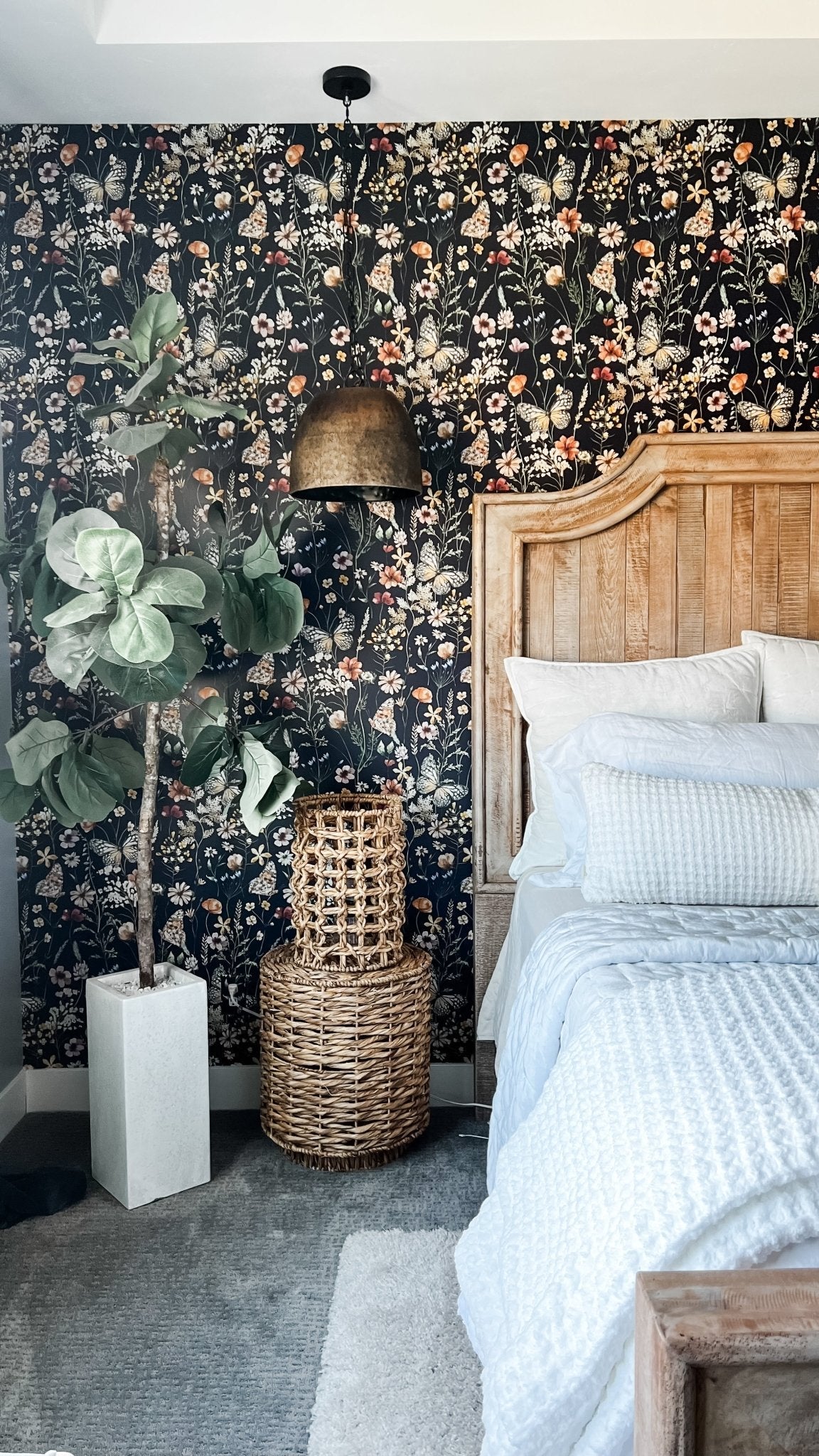
PHOTO CREDIT: @jenbryantdesign | WALLPAPER DESIGN: Butterfly (Black)
Dark wallpaper brings depth, warmth, and a sense of intention to a space. Whether you’re drawn to rich florals, deep blues, or moody neutrals, darker designs create walls that feel layered and considered.
One question that often comes up is how to minimize seams on dark wallpaper. Because of the contrast between the design and the base material, seams can sometimes be more visible than expected. Understanding why this happens and how to reduce it helps set clear expectations and leads to a much more polished finished result.

PHOTO CREDIT: @rockymountaindecals | WALLPAPER DESIGN: Midnight Wallflower
Why seams are more noticeable on dark wallpaper
Almost all wallpaper, regardless of type or brand, is printed on a white base material. This is simply how wallpaper is made. Because the material is white all the way through, the cut edges of each panel are also white.
When two panels meet, that white edge can sometimes show as a very fine line. On lighter wallpapers, this tends to blend in. On darker designs, the contrast makes seams easier to notice, especially before the room is fully styled or depending on lighting.
This is completely normal and not a flaw in the wallpaper. It is simply a result of how wallpaper is manufactured.

PHOTO CREDIT: @justdoitamanda | WALLPAPER DESIGN: Western
The most effective way to hide wallpaper seams
The simplest and most effective way to minimize visible seams on dark wallpaper is to soften the panel edges before installation.
By lightly coloring the white edge so it better matches the wallpaper, the seam visually disappears once the panels are installed side by side.
We recommend using a wipeable Crayola-style marker in a tone that closely matches your wallpaper. These are easy to control, forgiving if you make a mistake, and ideal for this purpose when used lightly.
A few helpful tips:
- Test your color on a wallpaper sample first
- Use a light hand and color only the edge, not the surface
- Avoid pressing firmly to prevent bleeding onto the design
- Focus on darker areas of the pattern if needed rather than the entire edge

PHOTO CREDIT: @athomewith_grace | WALLPAPER DESIGN: Deep Woodland Landscape
Installation plays a big role in seam visibility
Wallpaper seams are designed to meet edge to edge, not overlap. Taking your time during installation makes a noticeable difference in how clean the final wall looks.
Carefully aligning each panel and smoothing outward as you go helps ensure there are no gaps or tension pulling the seams apart over time.
It can also help to step back occasionally during installation. Looking at the wall from a distance often gives a more accurate sense of how visible seams will be once the room is complete.
What to expect once the room is finished
One important thing to keep in mind is that seams tend to be most noticeable during installation or before a room is styled.
Once furniture, decor, lighting, and natural shadows are in place, seams become much less noticeable. The overall pattern and color take over, and the wall reads as one cohesive surface.
This is especially true with darker, more detailed designs where the eye is naturally drawn to the pattern rather than the panel joins.

PHOTO CREDIT: @home_sweet_retreat | WALLPAPER DESIGN: Black Grasscloth
Final thoughts
Dark wallpaper is bold, expressive, and incredibly rewarding once installed. Understanding how wallpaper is made and taking a simple extra step like coloring the edges helps ensure the finished wall looks polished and cohesive.
When viewed as a complete space, seams fade into the background, allowing the color, pattern, and mood of the wallpaper to do what it does best: transform the room.
Frequently asked questions
Why are seams more visible on dark wallpaper?
Because wallpaper is printed on a white base material, the edges can contrast more against darker designs.
How do you hide seams on wallpaper?
Lightly coloring the edges with a matching marker before installation is the most effective method.
Should wallpaper seams overlap?
No. Wallpaper panels should be installed edge to edge, not overlapped.
Will wallpaper seams disappear over time?
They often become less noticeable once the room is fully styled and lighting softens the contrast.
Updated: April 2026